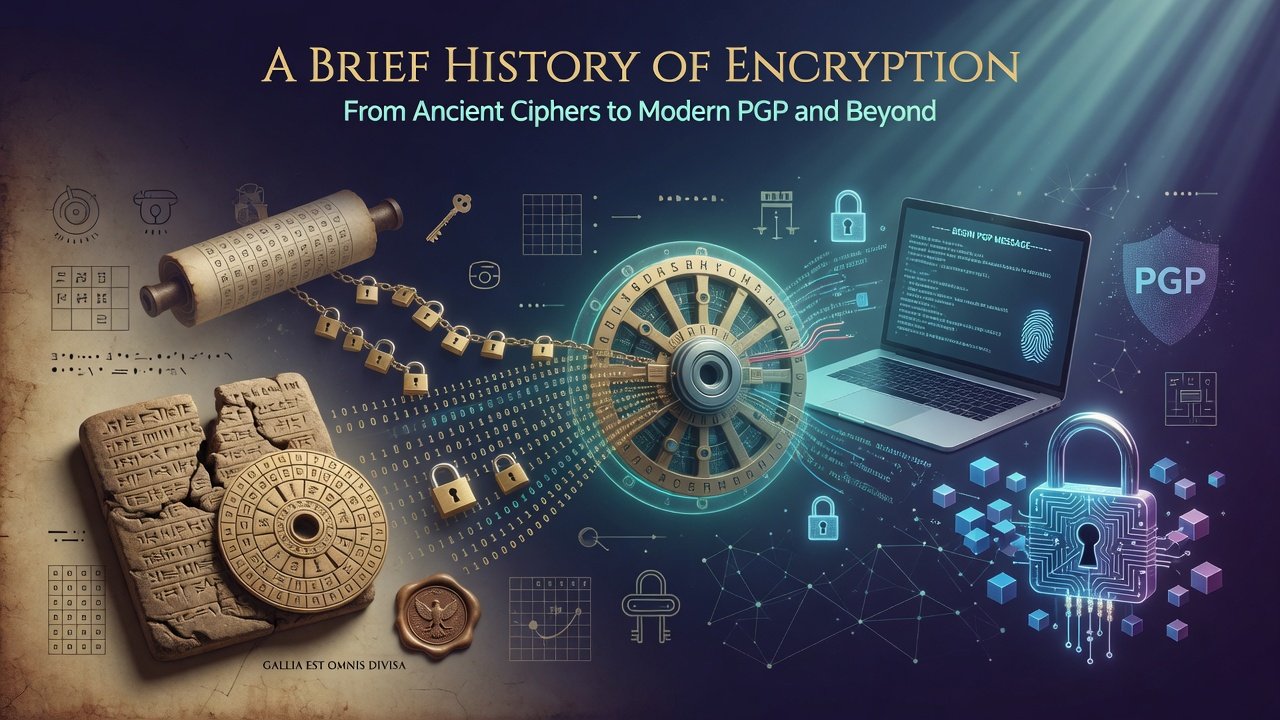
Encryption has evolved over millennia from basic letter shifts and physical tools like the scytale in ancient Egypt, Sparta, and Rome to sophisticated systems protecting modern communications. Early substitution and transposition ciphers gave way to frequency analysis, polyalphabetic methods such as the Vigenère cipher, and mechanical devices including the Enigma machine.
The digital era introduced public-key cryptography with RSA, followed by standards like DES and AES, as well as PGP for email security. Current developments address quantum threats through post-quantum algorithms and quantum key distribution while preserving core principles of confusion, diffusion, and secrecy.
A Brief History of Encryption: From Ancient Ciphers to Modern PGP and Beyond
Encryption has protected secrets for thousands of years, evolving from simple letter-shifting tricks into sophisticated algorithms that secure everything from emails to online banking. Today, tools like PGP encryption and AES stand as modern guardians of privacy, yet their roots trace back to ancient civilizations. Understanding the history of encryption reveals how humanity has continually battled to keep information safe from prying eyes.
Ancient Beginnings: The First Ciphers
The earliest recorded use of encryption dates to around 1900 BC in ancient Egypt, where hieroglyphs on tombs were deliberately altered to obscure meaning. However, systematic ciphers emerged later. In Sparta around 400 BC, the scytale—a leather strip wrapped around a wooden rod—created a transposition cipher. When unwrapped, the message appeared as gibberish until rewrapped on an identical rod.
Perhaps the most famous ancient method is the Caesar cipher, employed by Julius Caesar in 50 BC. This substitution cipher shifted letters in the alphabet by a fixed number, typically three positions. For example, “ATTACK” became “DWWDFN.” While elementary by today’s standards, it protected military dispatches effectively against illiterate enemies.
- Key ancient techniques: Scytale (transposition), Caesar cipher (substitution), and Atbash (Hebrew letter reversal).
- Limitation: These relied on shared secrets and offered minimal security against determined codebreakers.
Medieval and Renaissance Advances
During the Middle Ages, encryption grew more complex. Arab scholars in the 9th century, notably Al-Kindi, developed frequency analysis—the first systematic method to break substitution ciphers by studying letter occurrence patterns. This discovery forced cryptographers to innovate.
The Vigenère cipher, invented in 1553 by Giovan Battista Bellaso and later misattributed to Blaise de Vigenère, introduced polyalphabetic substitution. It used a keyword to shift letters variably, defeating simple frequency analysis for centuries. European courts and diplomats relied on such ciphers during the Renaissance, embedding messages in seemingly innocuous letters.
By the 17th century, nomenclators—codebooks mixing ciphers with code words—became standard in diplomatic communications. These early systems laid groundwork for structured cryptography still studied in the history of encryption.
The 19th Century and the Rise of Mechanical Encryption
The Industrial Revolution brought mechanical devices. In 1854, Charles Wheatstone created the Playfair cipher, a digraph substitution method used by the British military in World War I. It encrypted pairs of letters, adding another layer of complexity.
Telegraphy in the 1800s necessitated commercial encryption. Companies developed codebooks to reduce costs and protect trade secrets. Meanwhile, the American Civil War saw both Union and Confederate forces using simple ciphers, often broken quickly due to poor key management.
World War II: The Enigma Machine and Codebreaking Turning Points
No chapter in encryption history is more dramatic than World War II. The German Enigma machine used rotating rotors and plugboards to generate billions of possible substitutions daily. Initially considered unbreakable, Enigma messages were routinely decrypted at Bletchley Park by Alan Turing and his team using early computers like the Bombe.
The Japanese Purple cipher and Allied SIGABA machine further highlighted the arms race between encryption and cryptanalysis. These events proved that mechanical encryption could be defeated with sufficient computational power—a lesson that would shape postwar developments.
The Computer Age and Public-Key Cryptography
After 1945, encryption transitioned from mechanical to digital. In 1973, IBM developed the Data Encryption Standard (DES), adopted by the U.S. government in 1977. DES used a 56-bit key and became the global standard for financial transactions.
The real revolution arrived in 1976 when Whitfield Diffie and Martin Hellman introduced public-key cryptography. Instead of sharing a single secret key, this system used mathematically linked public and private keys. Anyone could encrypt with the public key, but only the private-key holder could decrypt.
In 1977, Ron Rivest, Adi Shamir, and Leonard Adleman created the RSA algorithm, based on the difficulty of factoring large prime numbers. RSA remains foundational to secure web browsing, digital signatures, and email encryption.
Modern Encryption: AES, PGP, and Everyday Security
The Advanced Encryption Standard (AES), selected by NIST in 2001, replaced DES with 128-, 192-, or 256-bit keys. AES powers Wi-Fi security (WPA2/WPA3), disk encryption (BitLocker, FileVault), and VPNs.
PGP (Pretty Good Privacy), created by Phil Zimmermann in 1991, brought strong public-key encryption to the masses. Originally designed to protect email, PGP combined symmetric and asymmetric cryptography with digital signatures. Its open-source descendant, OpenPGP, still secures activist communications and software distribution today.
Other milestones include:
- SSL/TLS protocols (1990s onward) enabling secure HTTPS connections.
- Elliptic Curve Cryptography (ECC) offering strong security with smaller keys, ideal for mobile devices.
- End-to-end encryption in messaging apps like Signal and WhatsApp.
Beyond Today: Quantum Threats and Post-Quantum Cryptography
Quantum computing poses the next existential challenge. Shor’s algorithm could theoretically break RSA and ECC by efficiently factoring large numbers. Governments and organizations are already standardizing post-quantum cryptography algorithms resistant to quantum attacks.
Meanwhile, quantum key distribution (QKD) offers theoretically unbreakable key exchange using quantum physics principles. Companies like ID Quantique and governments in China and Europe are deploying QKD networks for ultra-sensitive communications.
Conclusion: Encryption’s Enduring Legacy
From Caesar’s simple shifts to PGP encryption safeguarding digital privacy, the history of encryption mirrors humanity’s ongoing quest for confidentiality. Each advance in cryptography has prompted corresponding breakthroughs in cryptanalysis, driving innovation. As we enter the quantum era, the principles established by ancient ciphers—confusion, diffusion, and key secrecy—continue to guide researchers developing tomorrow’s standards. Whether protecting national secrets or personal messages, encryption remains one of civilization’s most vital technologies.
Word count: approximately 1480.