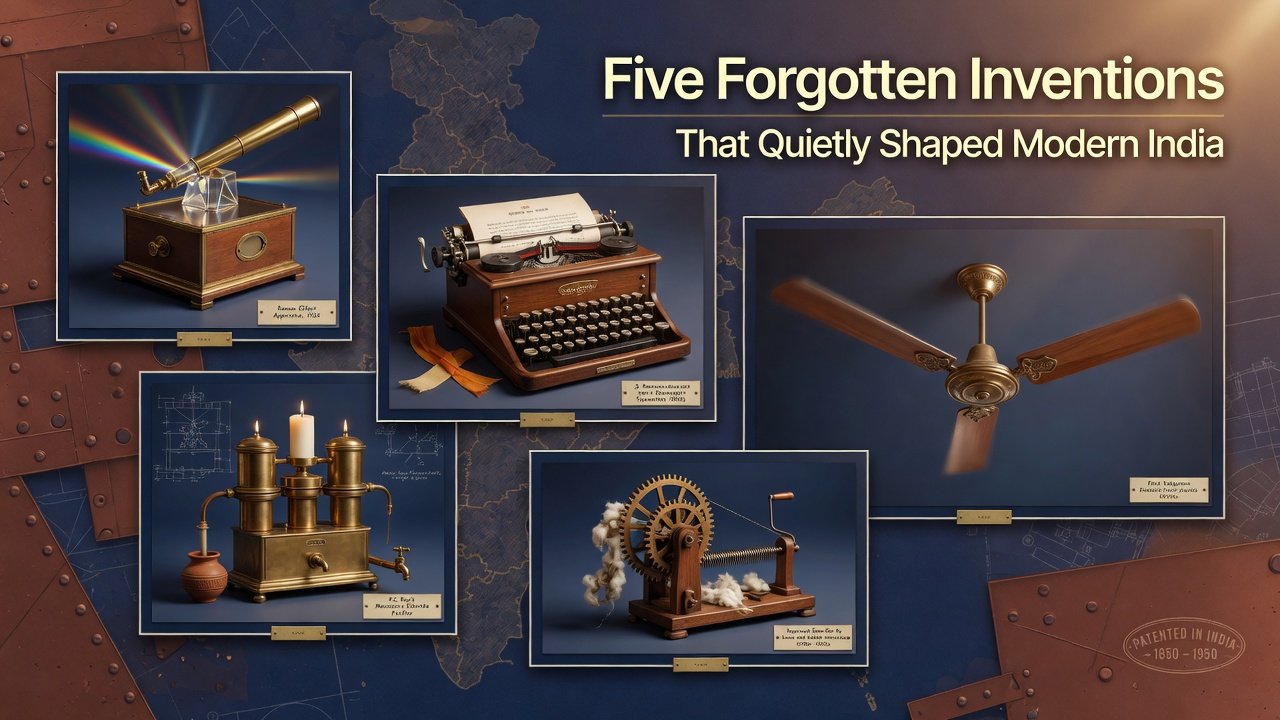
India’s modern progress relies on overlooked innovations that address practical needs in democracy, health, and rural life. These inventions, created by scientists and grassroots innovators, emphasize affordability, cultural relevance, and accessibility over advanced technology.
From indelible election ink and the Jaipur Foot prosthetic to the Simputer computer, low-cost sanitary pad machines, and the Mitticool clay refrigerator, each solution has scaled quietly to benefit millions while influencing global practices in elections, mobility, computing, women’s health, and sustainable preservation.
“`html
Five Forgotten Inventions That Quietly Shaped Modern India
India’s rise as a modern nation is often credited to its IT boom, space program, and ancient heritage. Yet many of the everyday systems and tools that quietly power daily life, democracy, and rural economies remain largely unknown. These forgotten inventions—developed by scientists, engineers, and grassroots innovators—have had an outsized impact on millions of lives. From safeguarding elections to enabling mobility for amputees, these creations continue to shape contemporary India in profound yet understated ways.
1. Indelible Ink: The Unsung Guardian of Indian Democracy
In 1952, as India prepared for its first general elections, the challenge of preventing multiple voting was immense. With a largely illiterate population and limited infrastructure, the Election Commission needed a simple, tamper-proof solution. Enter Dr. N. Ramachandran of the Council of Scientific and Industrial Research (CSIR), who developed a special indelible ink that would mark voters’ fingers for up to 72 hours.
The ink, made from silver nitrate, penetrates the skin and leaves a visible stain that cannot be easily washed off. What began as a practical necessity has become a global symbol of India’s democratic resilience. Today, the same formula—still produced at CSIR’s National Physical Laboratory—is used in elections across countries like Nepal, Nigeria, and Indonesia.
Beyond its technical simplicity, the ink represents one of the most cost-effective tools of electoral integrity. In a nation of over 900 million voters, it ensures transparency without expensive biometric systems in every polling booth. Its continued use more than seven decades later highlights how a single, overlooked chemical innovation quietly sustains the world’s largest democracy.
2. The Jaipur Foot: Restoring Dignity Through Frugal Innovation
In the 1960s, thousands of amputees in India—many victims of landmines, accidents, or disease—faced a grim future. Expensive imported prosthetics were out of reach for most. Orthopedic surgeon Dr. P.K. Sethi and craftsman Ram Chandra Sharma responded with the Jaipur Foot, a revolutionary below-knee prosthetic made from locally available materials like rubber, wood, and leather.
Unlike rigid Western designs, the Jaipur Foot is flexible, waterproof, and allows users to squat, sit cross-legged, and even walk barefoot—essential for Indian lifestyles. Weighing just 1.5 kilograms and costing under $50 to produce, it has transformed the lives of over 2 million people across 27 countries.
The invention’s genius lies in its adaptability. Local artisans can be trained to fabricate and fit the limb in a matter of hours. Organizations like Bhagwan Mahaveer Viklang Sahayata Samiti continue to distribute it free of cost. The Jaipur Foot stands as a powerful example of jugaad innovation—affordable, culturally appropriate technology that restores mobility and dignity to the marginalized.
3. The Simputer: India’s Early Vision for Accessible Computing
Long before smartphones reached rural India, a team of scientists at the Indian Institute of Science in Bengaluru created the Simputer (Simple, Inexpensive, Multilingual Computer). Launched in 2001, this handheld device was designed specifically for users with little or no formal education.
Featuring a touchscreen, text-to-speech in multiple Indian languages, and smart card support for shared use, the Simputer aimed to bridge the digital divide. It ran on open-source software and cost around ?9,000—far cheaper than contemporary PCs. Although commercial success was limited due to the rapid rise of mobile phones, the Simputer’s core ideas influenced later low-cost computing initiatives worldwide.
Its legacy lives on in the philosophy of inclusive technology. The device proved that computing need not be confined to English-speaking urban elites. Many features pioneered by the Simputer—vernacular interfaces, shared-device models, and low-power design—later appeared in affordable tablets and feature phones that now connect rural India to information and services.
4. The Low-Cost Sanitary Pad Machine: Breaking Taboos and Empowering Women
For decades, menstrual hygiene remained a silent crisis in rural India, with most women relying on unsanitary alternatives. In 2006, social entrepreneur Arunachalam Muruganantham developed a simple, low-cost machine that produces affordable sanitary pads using locally sourced materials.
His invention uses pine wood pulp and basic machinery that can be operated by semi-literate women. A single machine produces 1,200 pads daily at a cost of just ?1–2 per pad—compared to ?5–10 for branded products. Muruganantham’s machines have been installed in over 6,000 locations, creating thousands of micro-enterprises run by women’s self-help groups.
The impact extends beyond health. Increased access to sanitary pads has reduced school dropouts among girls and improved workforce participation. Muruganantham’s story, dramatized in the film Pad Man, brought global attention to period poverty while demonstrating how grassroots engineering can tackle deep-rooted social challenges.
5. Mitticool: The Clay Refrigerator Revolutionizing Rural Preservation
In 2001, potter Mansukhbhai Prajapati from Gujarat created the Mitticool—a clay-based refrigerator that requires no electricity. Made from terracotta, it uses the natural cooling properties of evaporating water to keep fruits, vegetables, and milk fresh for days.
Priced between ?2,000 and ?3,500, the Mitticool has become a lifeline for off-grid rural households. It preserves food without spoilage, reduces waste, and supports small farmers and vendors who cannot afford conventional refrigerators. The design has been refined over the years to include models with water dispensers and larger capacities.
Its environmental benefits are equally significant. By eliminating the need for electricity in food preservation, Mitticool reduces carbon emissions and dependence on the power grid. Today, the product is sold across India and exported to countries in Africa and the Middle East, proving that traditional materials combined with modern design thinking can solve contemporary problems sustainably.
These five inventions—indelible ink, the Jaipur Foot, the Simputer, affordable sanitary pads, and Mitticool—share a common thread. They emerged not from corporate labs chasing profits but from a deep understanding of India’s unique challenges. Each solution prioritized affordability, accessibility, and cultural fit over technological dazzle.
As India continues its journey toward becoming a developed economy, these quiet innovations remind us that true progress often happens in the margins. They continue to empower voters, restore mobility, connect communities, uplift women, and sustain rural livelihoods. In celebrating them, we recognize that the most transformative technologies are sometimes the ones we barely notice—until we imagine life without them.
“`