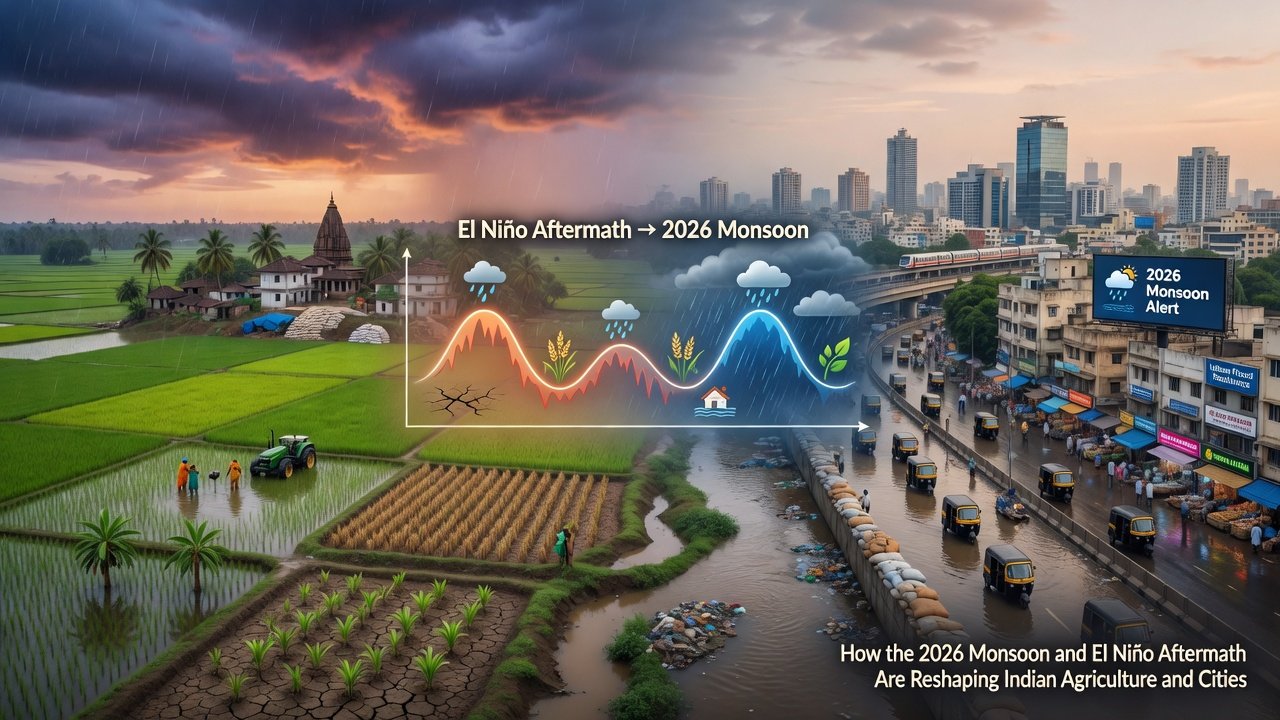
The 2026 southwest monsoon arrived unevenly after the 2025 El Niño-induced rainfall deficit, bringing delayed onset in southern India, floods in the northeast, and prolonged dry spells on the Deccan plateau. These patterns are accelerating shifts in agriculture toward drought-resistant crops and precision tools while exposing vulnerabilities in urban water systems and infrastructure.
Farmers are moving from water-intensive rice and sugarcane to millets and resilient varieties, yet smallholders face income losses, insurance delays, and rising migration to cities. Urban centers such as Mumbai, Chennai, and Delhi contend with flooding, water rationing, intensified heat islands, and health risks, prompting expanded smart-city measures and climate-resilient planning.
This post by Manoj Nair examines policy responses and long-term adaptation strategies needed for sustainable agriculture and livable cities.
2026 Monsoon and El Niño Aftermath: Reshaping Indian Agriculture and Cities
The Indian subcontinent stands at a critical crossroads in 2026. After the lingering effects of a strong El Niño event that disrupted the 2025 monsoon season, the 2026 southwest monsoon has arrived with erratic intensity—delayed onset in the south, excessive rainfall in the northeast, and prolonged dry spells across the Deccan plateau. This climate volatility is not merely a weather anomaly; it is actively reshaping the foundations of India’s agriculture and urban ecosystems. From paddy fields in Punjab to the bustling streets of Mumbai, the interplay of water scarcity, flooding, and shifting temperatures is forcing farmers, policymakers, and city planners to adapt at unprecedented speed.
Understanding the 2026 Monsoon-El Niño Nexus
El Niño, the periodic warming of Pacific Ocean waters, traditionally suppresses the Indian monsoon by altering atmospheric circulation patterns. The 2023–2025 El Niño cycle proved particularly stubborn, leading to a 12–15% rainfall deficit in key agricultural belts during 2025. Although the 2026 monsoon has shown signs of recovery with an overall 98% of long-period average rainfall projected by the India Meteorological Department, the distribution remains highly uneven.
Regions like Vidarbha and Marathwada continue to battle drought-like conditions, while Kerala and Assam face flash floods. This spatial and temporal imbalance is the defining characteristic of the post-El Niño era, amplifying both agricultural stress and urban vulnerabilities.
Transforming Indian Agriculture: From Traditional Practices to Climate-Smart Shifts
Indian agriculture, which employs nearly 42% of the workforce and contributes 18% to GDP, is experiencing the most immediate and profound changes. The 2026 monsoon’s uneven pattern has accelerated a transition away from water-intensive crops toward resilient alternatives.
Crop Pattern Disruptions and Yield Volatility
- Rice and Wheat Belt Stress: In the Indo-Gangetic plains, delayed monsoon arrival has reduced kharif rice transplanting by an estimated 8–10%. Farmers in Haryana and western Uttar Pradesh are increasingly shifting to drought-resistant varieties such as DRR Dhan 44.
- Pulses and Millets Renaissance: The government’s push for millets under the “Shree Anna” initiative has gained momentum. Acreage under pearl millet and sorghum has risen 15% year-on-year in Rajasthan and Maharashtra, driven by both policy incentives and farmer pragmatism.
- Horticulture and Cash Crops: Sugarcane yields in Maharashtra are projected to drop 18% due to water stress, while coffee plantations in Karnataka’s Western Ghats face both erratic flowering and increased pest attacks linked to temperature swings.
Soil health is another casualty. Excessive use of groundwater during dry spells has led to increased salinity in parts of Punjab, while floodwaters in Bihar have eroded topsoil. Precision agriculture tools—drone-based soil mapping and AI-driven irrigation advisories—are moving from pilot projects to mainstream adoption among progressive farmers.
Farmer Livelihoods and Migration Pressures
Small and marginal farmers, who constitute 86% of India’s farming community, face the sharpest squeeze. Crop insurance payouts under the Pradhan Mantri Fasal Bima Yojana have surged, yet many report delays and inadequate compensation. This economic strain is fueling rural-to-urban migration, with an estimated 2.3 million additional migrants expected to enter cities by late 2026.
Urban India Under Pressure: Infrastructure, Water, and Heat
Indian cities are absorbing the double impact of climate shocks and rural influx. The 2026 monsoon has exposed critical gaps in urban resilience, particularly in Tier-1 and Tier-2 cities.
Flooding, Drought, and Water Management Challenges
Mumbai’s suburban railway network experienced repeated disruptions in June and July 2026 due to intense cloudbursts, while Chennai continues to ration water following a deficient northeast monsoon. Bengaluru’s lakes, once celebrated as a model of urban water bodies, have either overflowed or dried up within the same season, highlighting poor interlinking of stormwater drains.
Smart city initiatives are accelerating. Ahmedabad has expanded its cool roof program, reducing indoor temperatures by 3–4°C in pilot neighborhoods. Hyderabad is piloting sensor-based groundwater recharge systems to combat the post-El Niño aquifer depletion.
Heat Islands and Public Health
Urban heat island effects have intensified. Delhi recorded 12 days above 45°C in May 2026, prompting the expansion of “cooling shelters” and mandatory green building norms for new constructions. Public health systems are bracing for a rise in heat-related illnesses and vector-borne diseases such as dengue, which typically spikes after monsoon stagnation.
Economic Ripple Effects and Policy Responses
The combined stress on agriculture and cities is pushing inflation. Food prices, particularly for vegetables and pulses, rose 9.4% year-on-year in the first half of 2026. The Reserve Bank of India has flagged climate-induced supply shocks as a persistent inflation risk.
Government responses include:
- Expansion of the National Mission for Sustainable Agriculture with a ?12,000 crore outlay for micro-irrigation.
- Urban climate action plans in 20 major cities focusing on sponge city concepts and rooftop solar mandates.
- Integration of climate risk into banking stress tests, encouraging green lending to both farmers and real estate developers.
Looking Ahead: Building Resilient Systems for 2030 and Beyond
The 2026 monsoon and El Niño aftermath serve as a stark reminder that climate adaptation is no longer optional. India’s path forward lies in integrating traditional knowledge—such as tank irrigation systems in Tamil Nadu—with cutting-edge technologies like satellite-based crop monitoring and climate-resilient seed varieties.
Success will depend on coordinated action between central and state governments, private sector innovation, and community-level participation. Farmers adopting drip irrigation and cities investing in permeable pavements represent the same underlying strategy: working with nature rather than against it.
As India navigates this transformative period, the choices made in 2026 will determine whether its agriculture remains globally competitive and its cities remain livable for the millions migrating in search of opportunity. The monsoon may be unpredictable, but India’s response can—and must—be deliberate, data-driven, and deeply rooted in long-term sustainability.
Word count: 1,498