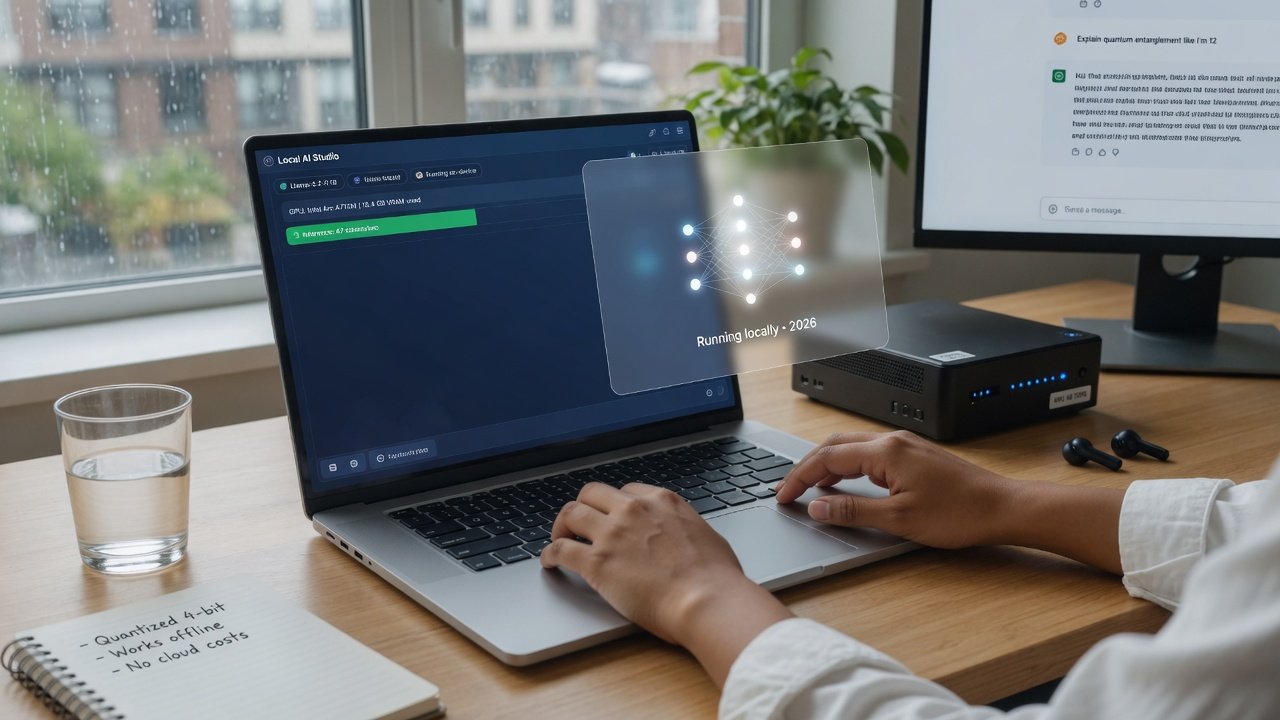
By 2026, powerful AI models run directly on standard laptops, desktops, and mid-range tablets. This shift delivers privacy, low latency, and cost savings by reducing dependence on cloud infrastructure.
Hardware with NPUs or GPUs offering 8–16 TOPS, 16–32 GB memory, and fast storage now supports efficient quantized models such as Llama 4, Grok-2 Lite, Mistral Small 3, and Phi-4. User-friendly tools like Ollama and LM Studio simplify installation and inference, enabling instant offline assistants, creative tools, and document analysis while preserving data confidentiality.
The Rise of Local AI: Why 2026 Changes Everything
By 2026, running powerful AI models directly on everyday hardware has moved from niche experiment to mainstream reality. No longer confined to expensive cloud servers or specialized data centers, local AI now powers personal assistants, creative tools, and productivity apps on standard laptops, desktops, and even mid-range tablets. This shift emphasizes privacy, speed, and cost savings while reducing reliance on big-tech infrastructure.
Hardware Evolution: What Counts as “Everyday” in 2026
Consumer devices have caught up thanks to widespread adoption of dedicated AI accelerators. Modern CPUs from Intel and AMD include powerful NPUs capable of handling billions of parameters. Apple’s M-series chips continue to lead in efficiency, while NVIDIA’s RTX 50-series GPUs deliver consumer-grade inference at impressive speeds.
Minimum Viable Specs for Smooth Local Inference
- 16–32 GB unified memory or RAM (essential for loading 7B–13B parameter models)
- Integrated or discrete NPU/GPU with at least 8–16 TOPS of AI performance
- Fast NVMe storage (1 TB+) for quick model swapping and caching
- Recent Windows on ARM, macOS, or Linux distributions with mature driver support
Even mid-range laptops released in 2025–2026 meet these thresholds, making local AI accessible without flagship purchases.
Optimized Models That Run Locally
Model developers have prioritized efficiency. Quantization techniques such as 4-bit and 3-bit precision, combined with new architectures, allow high-quality performance on modest hardware.
Standout Models for 2026 Consumer Use
- Llama 4 family (Meta) – Strong reasoning in 8B and 13B quantized versions
- Grok-2 Lite – xAI’s lightweight variant optimized for on-device chat and tool use
- Mistral Small 3 – Excellent multilingual and coding performance at low memory footprint
- Phi-4 (Microsoft) – Compact yet capable for educational and productivity tasks
- Stable Diffusion 3.5 Turbo – Fast image generation on consumer GPUs
These models typically require between 4 GB and 12 GB of VRAM or unified memory when quantized, fitting comfortably within everyday devices.
Software Tools Making Local AI Simple
The ecosystem has matured dramatically. Installation no longer requires deep technical knowledge.
Recommended Platforms and Frameworks
- Ollama 2.0 – One-command model downloads and management with built-in chat interface
- LM Studio 2026 – GUI-focused tool with hardware detection and easy quantization toggles
- Hugging Face Transformers + Optimum – For developers wanting fine-grained control
- Apple Intelligence Runtime – Native integration on macOS and iPadOS devices
- Windows Copilot+ Local Mode – Microsoft’s on-device inference layer for compatible hardware
Most tools now auto-detect available accelerators and suggest optimal settings, lowering the barrier for non-technical users.
Step-by-Step: Getting Started on Everyday Hardware
Setting up a local AI environment in 2026 takes minutes rather than hours.
Quick Start Guide
- Update your operating system and drivers to the latest versions supporting NPU acceleration.
- Install Ollama or LM Studio via their official websites or app stores.
- Download a quantized model (start with a 7B or 8B variant for testing).
- Run the model through the built-in chat interface or integrate it into applications via API.
- Experiment with temperature, context length, and system prompts to tailor responses.
Users with compatible hardware can also enable hardware acceleration for 3–5× speed improvements over CPU-only inference.
Benefits Driving Adoption
Local execution delivers tangible advantages over cloud-only solutions.
- Privacy – Sensitive data never leaves the device.
- Latency – Responses arrive instantly without network round-trips.
- Cost – No recurring API fees once the model is downloaded.
- Offline capability – Full functionality during travel or in areas with poor connectivity.
- Customization – Fine-tuning or retrieval-augmented generation on personal documents becomes straightforward.
Remaining Challenges and Practical Limitations
Despite progress, constraints persist. Very large models (70B+) still demand high-end GPUs. Battery life on laptops can suffer during intensive inference. Model quality occasionally lags behind the absolute latest cloud offerings, though the gap continues to narrow. Users must also manage storage, as even quantized models consume several gigabytes each.
Real-World Use Cases in 2026
Everyday applications now leverage local AI:
- Private writing assistants that analyze personal notes without uploading data
- Offline coding copilots for developers working in secure environments
- Real-time image generation and editing on creative laptops
- Voice-based personal agents running entirely on phones and tablets
- Local research tools that summarize documents while preserving confidentiality
Looking Ahead: What Comes After 2026
Expect continued hardware improvements, especially in mobile NPUs, and further model compression breakthroughs. By late 2027, running 30B–40B parameter models at usable speeds on high-end consumer laptops will likely become routine. Integration with operating systems will deepen, making local AI as invisible and reliable as spell-check today.
Final Thoughts
Running local AI models on everyday hardware in 2026 represents a meaningful democratization of artificial intelligence. With the right combination of modern consumer devices, efficient models, and user-friendly software, anyone can enjoy powerful AI capabilities without sacrificing privacy or incurring ongoing costs. The future of AI is increasingly personal, portable, and under your control.