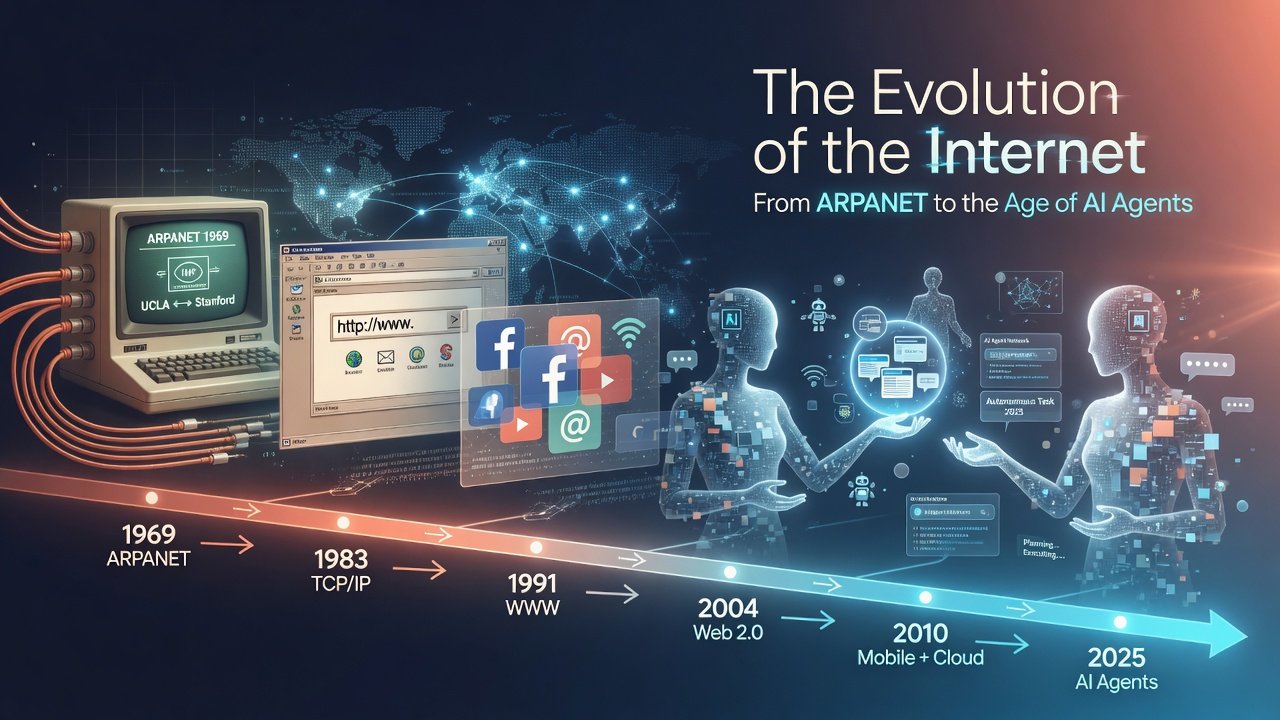
The internet evolved from ARPANET, a 1969 military-funded packet-switching network linking four university computers, into the foundation of global communication. Email appeared by 1971, TCP/IP standardized connections in the 1980s, and the World Wide Web launched in 1991 as a static, one-way information system.
Subsequent phases introduced interactivity through Web 2.0’s user-generated content and social platforms, followed by Web 3.0’s focus on decentralization, blockchain, and data ownership. Today, AI agents powered by large language models perform autonomous tasks, anticipate needs, and collaborate across systems, transforming the internet into an active partner while raising concerns about privacy, bias, and governance.
The Evolution of the Internet: From ARPANET to the Age of AI Agents
The internet has transformed from a modest military experiment into the backbone of modern civilization. What began as a way for researchers to share data has evolved into a dynamic ecosystem where AI agents anticipate our needs, automate tasks, and reshape how we interact with information. This journey—from ARPANET to the age of intelligent agents—reveals not just technological progress but a fundamental shift in human connection and productivity.
The Birth of the Internet: ARPANET and Packet Switching
In the late 1960s, the U.S. Department of Defense’s Advanced Research Projects Agency (ARPA) funded a groundbreaking project. ARPANET, launched in 1969, connected four university computers using packet-switching technology. This innovation allowed data to travel in small packets across multiple routes, making communication resilient even during failures.
By 1971, email emerged as the first “killer app,” and the network grew steadily. The 1980s saw the adoption of TCP/IP protocols, creating a standardized language for global networks. The term “internet” entered common usage, marking the shift from isolated systems to an interconnected web.
Web 1.0: The Static Information Highway
The public internet arrived with the World Wide Web in 1991. Tim Berners-Lee’s invention turned the internet into a readable, hyperlinked library. Early websites were static brochures—text-heavy, slow-loading, and one-directional. Users consumed content but rarely contributed.
Search engines like Yahoo! and AltaVista helped users navigate this growing digital frontier. E-commerce pioneers such as Amazon and eBay proved the commercial potential, setting the stage for the dot-com boom and subsequent bust.
Web 2.0: The Social and Participatory Revolution
Around 2004, the internet became interactive. Web 2.0 introduced user-generated content, social media, and dynamic platforms. Facebook, YouTube, and Twitter empowered anyone to publish, share, and collaborate in real time.
- Key features: AJAX for seamless updates, APIs for third-party integration, and mobile accessibility.
- Impact: The rise of the gig economy, viral marketing, and data-driven advertising.
This era democratized creation but also centralized power in a handful of platforms that monetized user attention.
Web 3.0: Decentralization, Semantics, and Ownership
The next phase emphasized machine-readable data and user sovereignty. Blockchain technology enabled cryptocurrencies and decentralized applications (dApps). Smart contracts automated trust, while the semantic web promised more intelligent search and personalization.
Web 3.0 introduced concepts like token-based economies and self-sovereign identity. Users began owning their data and digital assets rather than renting space on corporate servers.
The Rise of AI Agents: From Assistants to Autonomous Actors
Today we stand at the threshold of a new era defined by AI agents. Unlike simple chatbots, these agents reason, plan, and execute multi-step tasks across digital environments. Powered by large language models and reinforcement learning, they book travel, manage schedules, analyze markets, and even negotiate contracts.
Early examples include OpenAI’s GPT-powered tools and emerging platforms like AutoGPT and BabyAGI. These systems demonstrate goal-oriented behavior, memory retention, and tool use—capabilities that blur the line between software and digital coworkers.
How AI Agents Are Reshaping Internet Experiences
AI agents accelerate the internet’s evolution in several concrete ways:
- Personalized discovery: Agents sift through information overload to deliver context-aware recommendations.
- Automation at scale: Routine tasks like research, content creation, and customer support shift from humans to agents.
- Interoperability: Agents act as universal translators between apps, protocols, and data formats.
- Proactive assistance: Instead of waiting for queries, agents anticipate needs based on calendars, emails, and behavior patterns.
Businesses now deploy fleets of specialized agents that collaborate, dramatically reducing operational friction.
Challenges and Ethical Considerations
Rapid advancement brings risks. Data privacy concerns intensify when agents access personal information. Bias in training data can perpetuate unfair outcomes. Job displacement looms as agents handle cognitive work previously reserved for humans.
Security threats also evolve. Malicious agents could automate phishing, spread disinformation, or exploit vulnerabilities faster than defenses can respond. Governance frameworks lag behind technical capabilities, creating regulatory uncertainty.
The Road Ahead: Toward an Agentic Internet
Looking forward, the internet will likely become more agent-mediated. Voice and intent-based interfaces may replace traditional browsing. Decentralized identity systems could let users control how agents access their data. Hybrid human-AI teams will redefine productivity across industries.
Success depends on responsible design: transparent reasoning, human oversight, and alignment with societal values. The most successful platforms will balance autonomy with accountability.
Conclusion
From ARPANET’s humble four-node network to today’s intelligent AI agents, the internet’s evolution mirrors humanity’s growing ambition to connect, create, and automate. Each phase—static pages, social interaction, decentralization, and now agentic intelligence—has expanded what is possible while introducing new responsibilities.
As we enter the age of AI agents, the internet is no longer just a tool we use; it is becoming an active partner that thinks and acts on our behalf. The choices we make today about ethics, governance, and design will determine whether this next chapter empowers individuals or concentrates power further. One thing is certain: the story of the internet is far from over—it is only beginning to think for itself.
Word count: 1,498