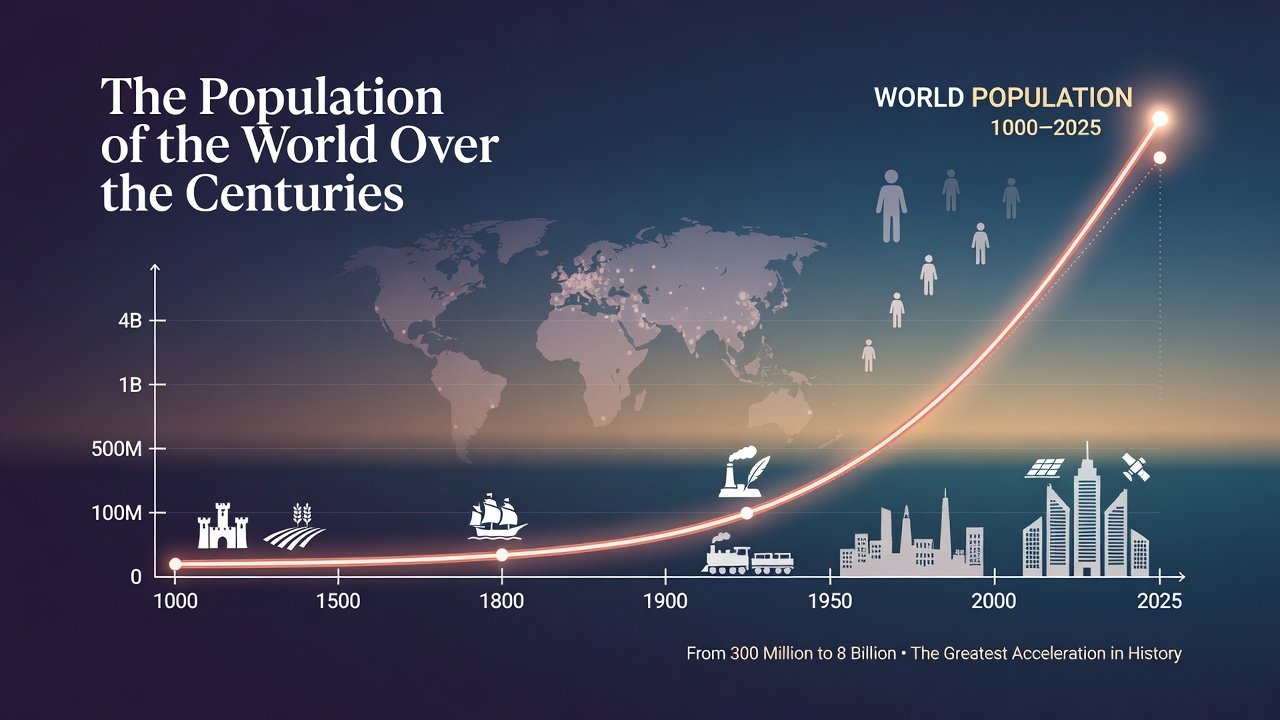
The global population grew from about 5 million around 10,000 BCE to over 8.1 billion today. Early stability gave way to steady increases after 1500, then explosive growth following the Industrial Revolution and 20th-century medical advances.
Key milestones include reaching 1 billion by 1800, 2 billion in 1927, and 6 billion by 1999. Current trends show slowing growth, rapid urbanization, aging populations in developed regions, and continued rises in sub-Saharan Africa, with projections peaking near 10.4 billion by the 2080s.
World Population History: Trends and Milestones Over the Centuries
The story of world population over the centuries reveals how humanity has grown from scattered tribes to a global community of more than 8 billion people. Tracking global population trends helps us understand the forces that shaped civilization, from ancient agriculture to modern medicine. This article explores key eras, dramatic shifts, and the factors behind explosive growth.
Ancient and Prehistoric Estimates
Before written records, estimating the population of the world over the centuries relies on archaeological and genetic data. Around 10,000 BCE, at the dawn of agriculture, the global population likely stood at roughly 5 million people. By 1 CE, estimates place the figure near 300 million, concentrated in fertile regions like the Nile Valley, Mesopotamia, and the Indus River.
Early civilizations faced high mortality from disease, famine, and warfare. Life expectancy hovered around 30 years, keeping numbers relatively stable for millennia. The Roman Empire at its peak supported perhaps 50–60 million inhabitants, while China’s Han Dynasty accounted for a similar share of the world total.
Medieval to Early Modern Eras (500–1800)
The medieval period brought both setbacks and gradual recovery. The Black Death in the 14th century wiped out an estimated 75–200 million people, temporarily reversing growth. Yet by 1500, the world population had climbed back to approximately 450–500 million.
Exploration, the Columbian Exchange, and new crops such as potatoes and maize fueled expansion in Europe and Asia. By 1800, the global population reached the symbolic milestone of 1 billion. This slow climb reflected incremental improvements in farming and sanitation rather than revolutionary change.
The Industrial Revolution and Explosive Growth (1800–1900)
The 19th century marked a turning point in world population history. Steam power, mechanized agriculture, and urban sanitation dramatically lowered death rates while birth rates remained high. By 1900, the population had surged to about 1.65 billion.
- Europe’s population doubled between 1800 and 1900.
- Asia remained the most populous continent but saw slower per-capita gains.
- Improved transportation allowed food surpluses to reach growing cities.
This era established the pattern of sustained demographic expansion that would define the next two centuries.
20th Century: From 1.6 Billion to 6 Billion
The 20th century witnessed unprecedented acceleration. Despite two world wars and the 1918 influenza pandemic, medical breakthroughs—vaccines, antibiotics, and clean water—drove life expectancy upward. The global population reached 2 billion by 1927, 3 billion by 1960, 4 billion by 1974, 5 billion by 1987, and 6 billion by 1999.
Asia accounted for most of this growth, with China and India each surpassing 1 billion. Africa’s population also began rising sharply after mid-century as colonial-era health programs took hold. Meanwhile, Europe and North America experienced declining fertility rates, foreshadowing later demographic shifts.
21st Century Trends and Future Projections
Today the population of the world over the centuries stands at roughly 8.1 billion. Growth has slowed from its peak rate of 2.1% in the 1960s to about 0.8% annually. Key trends include:
- Rapid urbanization, with more than half the world living in cities.
- Aging populations in developed nations.
- Continued but decelerating growth in sub-Saharan Africa.
United Nations projections suggest the world will reach 9 billion around 2037 and may peak near 10.4 billion by the 2080s before stabilizing or declining. These forecasts depend heavily on fertility trends in the world’s most populous countries.
Major Factors Shaping Population Changes
Several recurring drivers explain the dramatic arc of global population trends over centuries:
Agricultural and technological advances repeatedly expanded carrying capacity. The Neolithic Revolution, the Green Revolution of the 1960s, and today’s precision agriculture each unlocked new population thresholds.
Public health improvements reduced infant mortality and extended lifespans. Smallpox eradication and widespread immunization stand as landmark achievements.
Conflict, disease, and migration caused temporary declines but rarely altered long-term trajectories. The resilience of human population growth after major catastrophes remains striking.
Cultural and economic shifts, particularly women’s education and access to contraception, have emerged as powerful brakes on fertility in recent decades.
Conclusion: Lessons from Centuries of Growth
The population of the world over the centuries tells a story of remarkable adaptation. From fewer than 10 million people 12,000 years ago to over 8 billion today, humanity has repeatedly overcome limits through innovation. While future growth will likely be slower and more uneven, understanding these historical patterns helps policymakers prepare for challenges related to resources, aging societies, and sustainable development. The next chapters of world population history will be written by the choices societies make today.