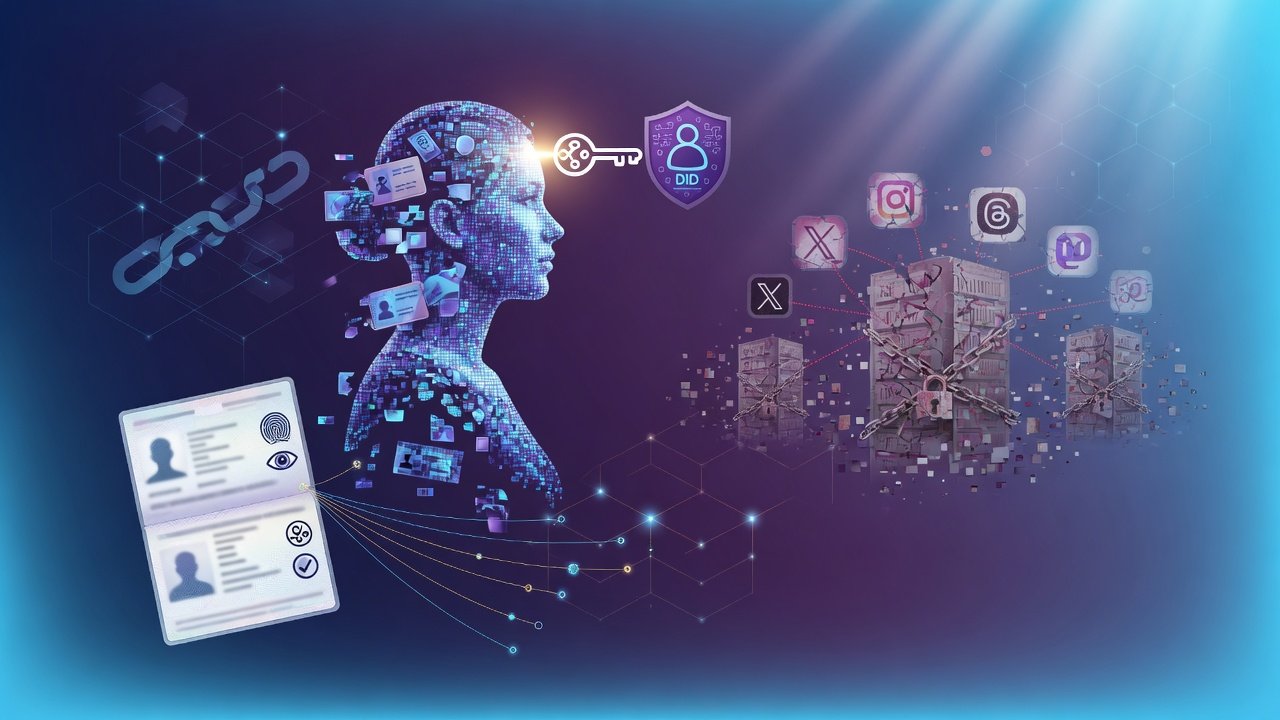
Decentralized identity, or self-sovereign identity, gives individuals control over personal data through cryptographic proofs, Decentralized Identifiers, and Verifiable Credentials. Unlike centralized systems, it enables selective disclosure and interoperability across finance, healthcare, travel, and other sectors without relying on public blockchains for every transaction.
Decentralized social networks address content moderation and platform control but often lack robust identity foundations, leading to issues with spam, recovery, and fragmentation. A strong decentralized identity layer serves as essential infrastructure that can strengthen social platforms while delivering broader privacy, regulatory compliance, and fraud reduction benefits.
The push toward decentralization in tech has captured imaginations across industries, but not all decentralized solutions carry equal weight. While decentralized social networks like Mastodon, Bluesky, and Nostr generate headlines for challenging centralized platforms, decentralized identity remains the more foundational and enduring priority. It underpins trust, privacy, and interoperability in ways that social applications alone cannot achieve.
Understanding Decentralized Identity
Decentralized identity, often called self-sovereign identity (SSI), shifts control of personal data from corporations and governments back to individuals. Instead of relying on a single provider to store and verify credentials, users hold cryptographic proofs in digital wallets. Standards such as Decentralized Identifiers (DIDs) and Verifiable Credentials (VCs) allow anyone to prove attributes—like age, education, or employment—without exposing unnecessary details.
This model draws from cryptographic principles similar to blockchain but does not require a public ledger for every interaction. Users generate unique identifiers for different contexts, minimizing correlation risks. The result is a portable, privacy-preserving layer that works across services, from finance to healthcare to travel.
Core Components of Decentralized Identity Systems
- Decentralized Identifiers (DIDs): Unique, user-controlled strings resolvable to cryptographic keys and service endpoints.
- Verifiable Credentials: Tamper-evident digital documents issued by trusted parties and stored by the user.
- Wallets and Agents: Software that manages keys, presents proofs, and negotiates selective disclosure.
The Appeal and Limits of Decentralized Social Networks
Decentralized social platforms promise freedom from algorithmic manipulation and content moderation by distant corporations. Users can migrate between servers or run their own, theoretically reducing single points of failure. However, these networks still struggle with identity fundamentals. Account recovery often depends on email or phone numbers tied to centralized providers. Spam, impersonation, and bot activity proliferate because there is no reliable way to prove uniqueness or reputation across instances.
Many projects attempt to bolt on decentralized identity features after launch, yet integration remains inconsistent. Without a shared identity layer, each network recreates its own verification problems, leading to fragmented user experiences.
Why Decentralized Identity Holds Greater Strategic Importance
Identity serves as infrastructure rather than an application. Social networks are one use case among many; decentralized identity enables secure interactions in finance, supply chains, voting, and professional credentials. When users control their own identity data, they reduce exposure to mass data breaches that plague centralized databases.
Interoperability emerges naturally. A credential issued by a university can be verified by an employer, a bank, or a government portal without custom integrations. This portability contrasts sharply with social networks, where data remains siloed even in federated environments.
Privacy and Regulatory Advantages
Decentralized identity aligns closely with regulations such as GDPR and emerging data protection laws. Selective disclosure allows users to reveal only the minimum information required. Zero-knowledge proofs further strengthen this by enabling verification without revealing the underlying data at all. Centralized social platforms, even decentralized ones, rarely offer comparable granularity, increasing compliance costs and user risk.
Real-World Use Cases Beyond Social Media
Consider digital travel credentials. Instead of carrying physical passports or uploading scans to airline apps, travelers could present a verifiable credential stored in their phone wallet. Border authorities verify authenticity without storing personal data themselves. Similar patterns apply to professional licenses, medical records, and supply-chain attestations.
In decentralized finance, proof of personhood becomes critical for preventing Sybil attacks in governance and airdrops. Projects experimenting with decentralized identity solutions demonstrate lower fraud rates and more equitable token distribution compared to social-graph-based approaches alone.
Adoption Barriers and Practical Progress
Despite clear advantages, decentralized identity faces usability hurdles. Key management remains complex for average users, and wallet interfaces often prioritize crypto traders over everyday credential holders. Standardization efforts by organizations such as the Decentralized Identity Foundation and W3C continue to mature, yet wallet-to-wallet interoperability is still evolving.
Enterprise pilots in education and healthcare show promising traction. Governments in several countries have launched verifiable credential programs for driver’s licenses and vaccination records, proving that institutional buy-in is achievable when clear efficiency gains exist.
Comparing Impact: Identity as Foundation, Social Networks as Layer
Decentralized social networks address symptoms of platform centralization—content ownership and moderation—while decentralized identity tackles the root cause: lack of user-controlled data portability and verification. A robust identity layer can actually improve social networks by enabling portable reputation, verified accounts, and cross-platform moderation tools without sacrificing privacy.
Without identity infrastructure, social decentralization risks remaining fragmented and vulnerable to the same abuses seen on centralized platforms. With it, new forms of coordination become possible across both social and non-social domains.
Looking Ahead
The trajectory of digital identity will likely determine how much autonomy individuals retain in an increasingly connected world. While decentralized social networks capture attention through visible user migration and cultural debates, the quieter work on decentralized identity builds the rails for everything else. Prioritizing verifiable, user-controlled credentials delivers compounding benefits that extend far beyond any single application category.
Organizations and developers investing in this space position themselves for a future where trust is cryptographic rather than institutional, and users—not platforms—own their digital presence.