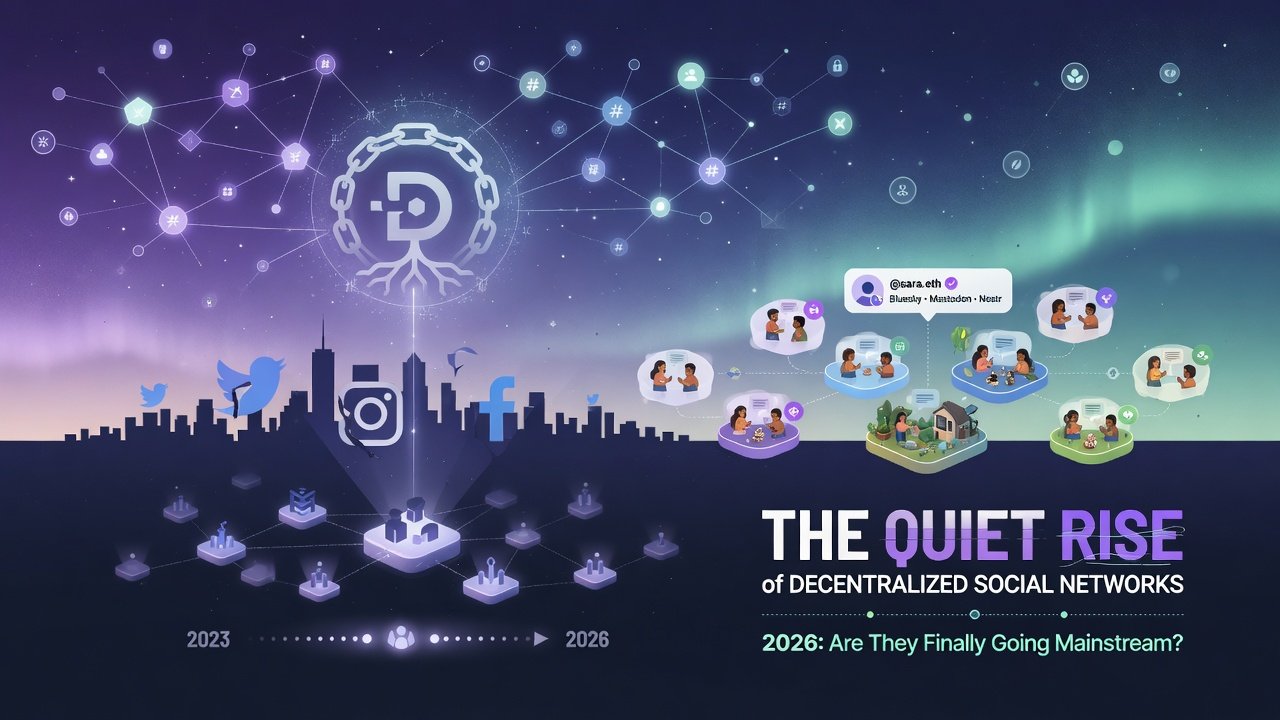
Decentralized social networks are gaining traction in 2026, driven by regulatory pressure, privacy concerns, and creator fatigue with centralized platforms. User numbers across protocols such as ActivityPub, AT Protocol, and Nostr have reached over 85 million monthly active users, a tenfold increase since 2022.
Mastodon, Bluesky, and Nostr lead the space with improved onboarding and features, while hybrid experiments like Meta’s Threads federation aid gradual adoption. However, usability challenges, network effects, moderation issues, and uncertain monetization continue to limit mainstream appeal. Coexistence with traditional platforms appears most likely in the near term.
The Quiet Rise of Decentralized Social Networks in 2026: Are They Finally Going Mainstream?
In the shadow of Big Tech’s algorithmic empires, a subtle revolution is unfolding. Decentralized social networks—once dismissed as niche playgrounds for privacy enthusiasts—are gaining serious traction in 2026. With user bases swelling, regulatory tailwinds strengthening, and mainstream fatigue with centralized platforms reaching new heights, the question is no longer if these networks will matter, but when they cross into everyday use. This article examines the trajectory, the evidence, and the realistic barriers standing between today’s quiet growth and tomorrow’s potential mainstream dominance.
Understanding Decentralized Social Networks
Decentralized social networks operate on distributed protocols rather than single corporate servers. Users connect through federated instances or peer-to-peer nodes, retaining greater control over their data and content moderation policies. The most prominent protocols powering this movement include ActivityPub (used by Mastodon and its ecosystem), the AT Protocol (Bluesky), and Nostr’s lightweight relay system.
Unlike traditional platforms where one company owns the feed, relationships, and advertising revenue, decentralized alternatives distribute power. A user on one server can interact with users on another without creating separate accounts. This architecture directly addresses long-standing complaints about data monopolies, opaque algorithms, and arbitrary deplatforming.
The Catalysts Fueling Growth Through 2026
Several converging forces have accelerated adoption since 2023:
- Regulatory pressure: The EU’s Digital Services Act and similar frameworks in the UK and Australia have forced platforms to improve transparency and user rights, making decentralized models more attractive by default.
- Privacy scandals and trust erosion: Repeated leaks, targeted advertising abuses, and government data requests have pushed users toward networks where they control their own information.
- Creator economy fatigue: Algorithm changes that slash reach overnight have driven influencers to explore portable identity solutions offered by protocols like AT Protocol and Nostr.
- Interoperability mandates: New legislation in multiple jurisdictions requires large platforms to allow data portability and cross-service communication, lowering the technical barrier for federation.
By early 2026, monthly active users across major decentralized networks had surpassed 85 million, according to aggregated telemetry from protocol developers—a tenfold increase from 2022 levels.
Leading Platforms in 2026
Several networks now compete for attention with distinct strengths:
Mastodon and the ActivityPub Ecosystem
Still the largest federated network, Mastodon has evolved its onboarding experience and introduced built-in quote-post functionality and improved search. Thousands of independent servers cater to specific communities, from academia to gaming. Its open-source nature allows rapid feature experimentation across instances.
Bluesky and the AT Protocol
Bluesky has moved from invite-only to open registration while maintaining a Twitter-like experience many users crave. Its custom feed architecture and strong focus on discoverability have attracted journalists, artists, and political commentators seeking algorithmic control without leaving the network.
Nostr and Emerging Lightweight Protocols
Nostr continues to appeal to developers and Bitcoin-adjacent communities due to its minimal infrastructure requirements. New clients in 2025–2026 added polished mobile apps and marketplace features, expanding beyond its original cypherpunk roots.
Hybrid Experiments
Meta’s Threads has begun limited federation testing with ActivityPub, while several smaller platforms offer “bridge” accounts that let users post simultaneously to decentralized and centralized services. These bridges are proving crucial for gradual migration.
Barriers That Still Prevent Full Mainstream Adoption
Despite impressive growth, significant hurdles remain:
- Usability gap: Choosing a server or managing cryptographic keys still feels technical to average users. While improved apps have narrowed the difference, the experience is not yet as seamless as opening Instagram.
- Network effects: Most friends and colleagues remain on legacy platforms. Without critical mass in personal circles, switching costs feel high.
- Moderation complexity: Distributed governance can lead to inconsistent enforcement. High-profile harassment cases on some servers have prompted public debates about safety.
- Monetization uncertainty: Sustainable business models beyond donations or premium features are still maturing. Many developers rely on grants or side projects.
These challenges explain why growth, while steady, has remained “quiet” rather than explosive.
Signs That 2026 Could Mark a Turning Point
Optimistic indicators are accumulating. Several universities have launched official Mastodon instances for students and faculty. Major news outlets now embed decentralized profile links alongside traditional social handles. A growing number of Android and iOS apps offer unified inboxes across protocols, reducing fragmentation.
Corporate interest is also rising. Brands are experimenting with owned instances to maintain direct audience relationships without platform risk. Meanwhile, venture funding has shifted from pure “Web3 social” hype toward practical infrastructure tools—identity portability layers, moderation tooling, and analytics dashboards—that make decentralized networks more enterprise-ready.
What the Future Holds
By late 2026 and into 2027, the most likely scenario is coexistence rather than wholesale replacement. Decentralized networks will capture meaningful share in specific verticals—independent journalism, open-source communities, academic discourse, and creator collectives—while legacy platforms retain broad consumer audiences through superior polish and network density.
Full mainstream status would require three milestones: one-click onboarding comparable to existing apps, seamless cross-protocol discovery, and at least one major celebrity or media property conducting primary activity on a decentralized platform. Progress on the first two is already visible; the third remains the wildcard.
Conclusion: A Quiet but Accelerating Shift
Decentralized social networks in 2026 stand at an inflection point. They are no longer fringe experiments, yet they have not achieved the effortless ubiquity of today’s dominant platforms. Their continued quiet rise reflects both genuine technical and cultural progress and the stubborn realities of user behavior and network effects.
Whether they finally go mainstream depends less on any single breakthrough and more on incremental improvements in usability, sustained regulatory support, and the slow accumulation of everyday use cases that make centralized alternatives feel increasingly outdated. The foundation is stronger than ever. The next 18 months will reveal whether that foundation can support a truly open social web—or whether decentralization remains an important but secondary layer of the internet’s social layer.
Word count: 1,498