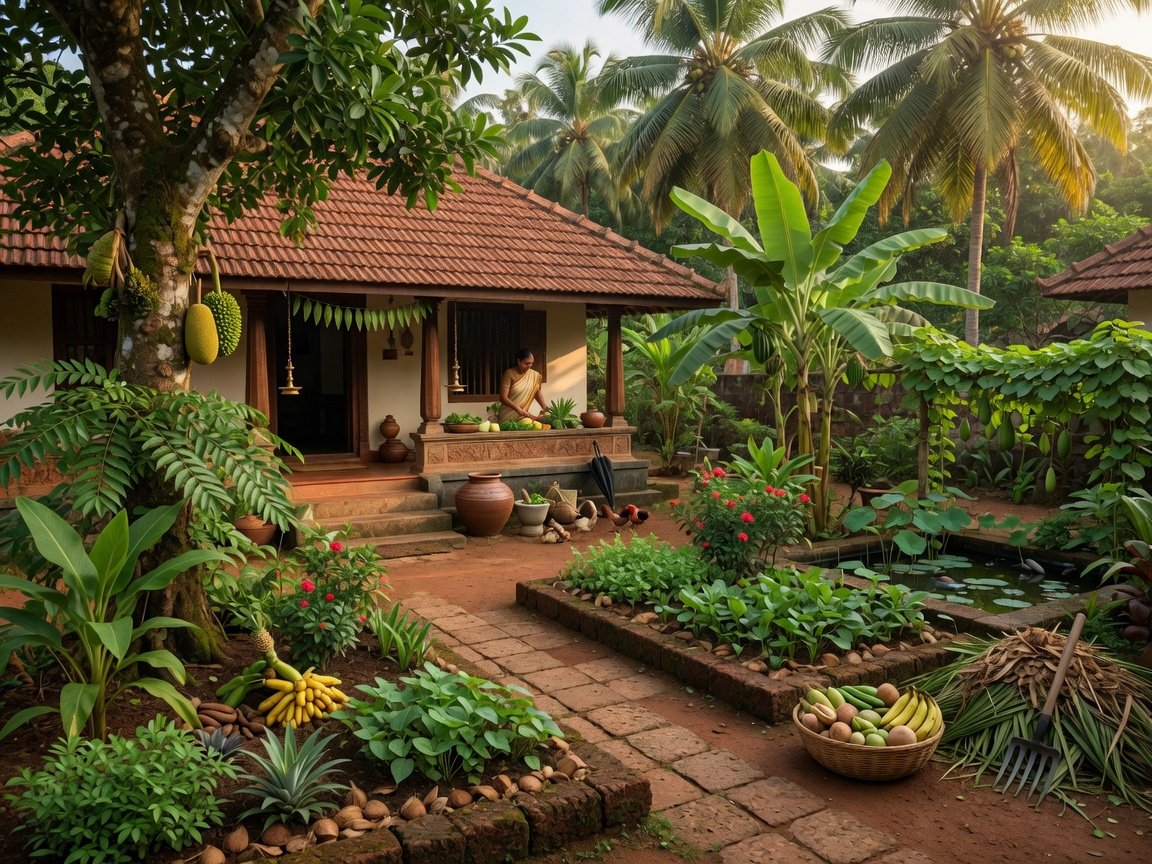
Kerala’s traditional homestead gardens, called thottam or purayidam, integrate fruit trees, spices, vegetables, herbs, and livestock in multi-layered systems that mimic natural forests. These small plots have long provided families with food, medicine, fuel, and income while requiring minimal external inputs.
The gardens achieve resilience through high biodiversity, seed saving, circular resource use, and vertical planting that maximizes space and buffers against weather extremes. They also transmit practical knowledge across generations, support community ties, and demonstrate ecological balance that remains relevant for modern self-reliance in both rural and urban settings.
Kerala’s traditional homestead gardens, known locally as thottam or purayidam, represent a living blueprint for self-reliance that has sustained families for generations. Nestled around ancestral homes, these multilayered gardens combine fruit trees, spices, vegetables, medicinal herbs, and livestock in a harmonious system that minimizes external dependence. In an era of global supply-chain fragility and rising food costs, these gardens offer timeless lessons in resilience, resourcefulness, and ecological balance.
The Structure of a Traditional Kerala Homestead Garden
Unlike monoculture farms, Kerala’s homestead gardens mimic natural forests. Tall coconut palms form the canopy, while banana, jackfruit, and mango occupy the next layer. Beneath them grow turmeric, ginger, and leafy greens, with ground covers such as colocasia and yams completing the vertical integration. This multi-tiered design maximizes space on small plots—often just half an acre—while ensuring year-round harvests.
The system evolved from Kerala’s unique geography of wetlands, hills, and coastal plains. Families historically relied on these gardens for food, medicine, fuel, and even building materials. Coconut provided oil, timber, and thatch; jackfruit served as both staple and timber; and a diverse array of herbs treated common ailments without pharmacy visits.
Key Plants and Their Roles
- Coconut palm: The “tree of life” supplying food, oil, and copra for income.
- Banana and plantain: Quick-yielding staples that thrive in partial shade.
- Spices: Black pepper, cardamom, and nutmeg grown on living supports for cash and culinary use.
- Medicinal species: Tulsi, neem, and aloe vera forming a natural first-aid kit.
- Root crops: Tapioca and yams providing calorie security during lean seasons.
Food Security Through Diversity and Seasonality
Self-reliance begins with never depending on a single crop. Traditional gardens feature more than 50 plant species, ensuring that even if one fails due to pests or weather, others compensate. This biodiversity buffers against monsoon failures and seasonal shortages that plague industrial agriculture.
Families practiced seed saving and crop rotation long before these became buzzwords. Surplus produce was shared or bartered within the community, creating social safety nets. During crises—whether colonial famines or modern lockdowns—these gardens continued supplying fresh vegetables and fruits when markets emptied.
Economic Independence and Circular Resource Use
Homestead gardens reduced cash outflow dramatically. Instead of buying vegetables, cooking oil, or firewood, households produced them on-site. Excess coconuts or spices could be sold, generating modest income without large landholdings. Livestock integrated into the system—cows fed on garden waste and returned manure—closed the nutrient loop.
This circular economy model teaches a powerful lesson: waste is a misplaced resource. Fallen leaves became mulch, kitchen scraps fed chickens or compost, and rainwater was harvested in simple ponds. The result was low-input, high-output productivity that supported entire families with minimal external purchases.
Ecological Wisdom and Climate Resilience
Long before climate change entered public discourse, Kerala gardeners understood ecosystem services. The dense planting conserved soil moisture during dry spells and prevented erosion on slopes. Deep-rooted trees improved groundwater recharge, while the canopy moderated temperatures. These gardens acted as micro-carbon sinks and pollinator havens.
Today, as erratic rainfall and rising temperatures challenge farmers, the same principles offer adaptation strategies. Home gardens require far less irrigation than paddy fields and maintain productivity even when commercial monocultures falter.
Cultural and Social Dimensions of Self-Reliance
Beyond material benefits, these gardens fostered knowledge transmission across generations. Children learned plant identification, seasonal timing, and basic medicine by participating in daily garden chores. Women often managed the gardens, gaining economic agency within the household.
Community seed exchanges and collective harvesting reinforced social bonds. The garden was not merely a production unit but a cultural anchor that preserved traditional recipes, Ayurvedic practices, and festivals tied to harvest cycles.
Practical Lessons for Contemporary Life
Modern households can adapt Kerala’s model even in urban settings. Start small with container herbs and vertical growing on balconies. Prioritize multi-purpose plants that deliver food, medicine, and beauty. Compost kitchen waste to regenerate soil rather than relying on chemical fertilizers.
Key actionable takeaways include:
- Design for vertical layers to maximize limited space.
- Choose climate-resilient, locally adapted varieties over exotic hybrids.
- Integrate animals or beneficial insects for natural pest control.
- Save seeds and propagate plants to reduce dependency on commercial nurseries.
- Track seasonal abundance to plan preservation and sharing.
Scaling the Model Today
Government initiatives like Kerala’s Haritha Keralam and various urban-greening programs already draw inspiration from traditional gardens. Individuals can replicate the approach by mapping sunlight patterns, testing soil, and gradually adding layers over seasons. Digital communities now share seed swaps and troubleshooting tips, extending the old barter networks online.
Conclusion: Reclaiming Agency Through Garden Knowledge
Kerala’s homestead gardens demonstrate that self-reliance is not isolation but intelligent interdependence—with nature, community, and one’s own labor. In a world facing ecological uncertainty and economic volatility, these gardens remind us that security begins at home. By embracing biodiversity, circular resource flows, and generational knowledge, anyone can cultivate greater autonomy and resilience. The lessons are ancient, yet their relevance has never been more urgent.