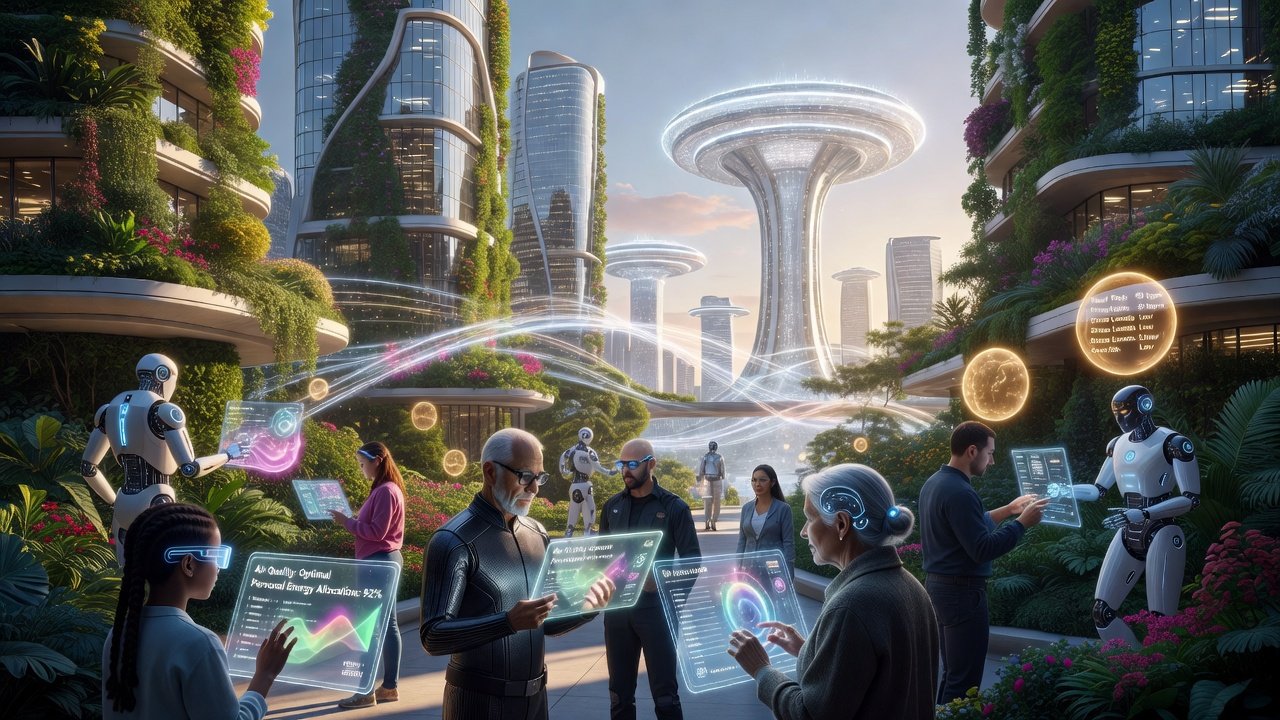
AI will permeate society by 2074, shifting from tools to an invisible architect across healthcare, work, climate, education, and daily life. It promises predictive medicine, automated economies, ecosystem restoration, personalized learning, and responsive cities while raising ethical, governance, and identity challenges.
The trajectory depends on current advances in machine learning, robotics, and data systems. Outcomes hinge on alignment, equity, and international oversight to favor abundance and human flourishing over inequality or loss of agency.
How AI Will Reshape the World in 50 Years
By 2074, artificial intelligence will have evolved far beyond today’s chatbots and recommendation engines. It will permeate every layer of human existence, acting as an invisible architect of society. From personalized medicine to climate restoration, AI promises both unprecedented abundance and complex ethical dilemmas. This article explores the most probable transformations, grounded in current trajectories of machine learning, robotics, and data science.
Healthcare: From Treatment to Prevention and Longevity
AI will shift medicine from reactive care to continuous, predictive wellness. Wearable and implantable sensors will feed real-time biometric data into personal AI health agents. These systems will detect diseases like cancer or Alzheimer’s years before symptoms appear, enabling interventions that extend healthy lifespans to 100+ years for many.
- Personalized drug design — AI will create bespoke pharmaceuticals in hours rather than years.
- Robotic surgeons — Autonomous systems will perform complex procedures with zero human fatigue.
- Mental health companions — Empathetic AI therapists will provide 24/7 support, reducing stigma and access barriers.
Global health inequality may narrow as low-cost AI diagnostics reach remote regions, though data privacy and access equity will remain critical challenges.
Work, Economy, and the Post-Scarcity Question
Automation will eliminate most routine cognitive and physical jobs. Transportation, manufacturing, legal research, and even creative coding will be largely handled by specialized AI agents. In response, societies will likely adopt variations of universal basic income funded by AI-driven productivity gains.
New professions will emerge around AI oversight, synthetic biology design, and human-AI collaboration. The concept of “work” may shift toward meaning-making activities—art, exploration, community building—rather than survival. However, wealth concentration among AI owners could exacerbate inequality unless robust redistribution mechanisms are implemented.
Climate, Energy, and Environmental Restoration
AI will become the primary tool for managing planetary systems. Advanced climate models will run in real time, optimizing carbon capture, reforestation, and renewable energy grids with precision impossible for humans.
- Autonomous drones and robots will restore ecosystems at scale.
- AI-managed fusion or next-generation nuclear plants will deliver near-limitless clean energy.
- Precision agriculture powered by AI will feed 10 billion people while using 70% less water and land.
By 2074, AI-orchestrated geoengineering could stabilize global temperatures, though governance of such powerful interventions will require new international frameworks.
Education and Human Augmentation
Learning will become lifelong and hyper-personalized. AI tutors will adapt to each individual’s cognitive style, emotional state, and goals, compressing years of traditional education into months. Brain-computer interfaces may allow direct knowledge transfer, raising questions about authenticity and human identity.
Creativity will flourish as AI handles technical execution, freeing humans to focus on vision and emotion. The distinction between “human-made” and “AI-assisted” art will blur, prompting new cultural norms around authorship.
Ethics, Governance, and Existential Risk
The most profound changes will involve power and control. Superintelligent systems may negotiate treaties, draft legislation, and manage infrastructure with minimal human input. This raises urgent questions:
- Who aligns AI values with humanity’s diverse moral frameworks?
- How do we prevent authoritarian regimes from weaponizing autonomous systems?
- What rights, if any, should advanced AI entities possess?
Global AI governance treaties, similar to nuclear non-proliferation agreements, will likely emerge. Transparent, auditable AI architectures and international oversight bodies could mitigate catastrophic risks while preserving innovation.
Daily Life and Human Identity
Cities will become responsive organisms. Traffic, waste, energy, and public safety will be managed by interconnected AI networks that anticipate needs before they arise. Virtual and augmented realities will be indistinguishable from physical environments, enabling seamless work, travel, and social connection from anywhere.
Human identity itself will evolve. Many people will maintain continuous relationships with long-lived AI companions. The boundary between biological and digital minds may soften through neural interfaces, prompting philosophical debates about consciousness and mortality.
Conclusion: A Fork in the Road
In 50 years, AI will not merely assist humanity—it will co-create the future. The outcome depends less on technological capability and more on the wisdom with which we design incentives, institutions, and ethical guardrails today. Optimistic scenarios point to abundance, extended health, and creative flourishing. Pessimistic ones warn of surveillance states and loss of human agency.
The next five decades offer a narrow window to shape these trajectories. By prioritizing alignment, equity, and transparency, society can steer AI toward becoming the greatest force for human flourishing in history rather than its greatest threat.