The World’s 5 Most Expensive Paintings Ever Sold
Art collecting at the highest level often makes headlines for eye-watering prices. From Renaissance masterpieces to abstract expressionist icons, the world’s costliest paintings command tens or even hundreds of millions of dollars. Whether sold at auction or through private deals, these works represent not only artistic genius but also status symbols for billionaires and institutions. In this article, we explore the five most expensive paintings in the world, ranked by verified sale prices, and uncover the stories behind each record-breaking acquisition.
1. Salvator Mundi – Leonardo da Vinci ($450.3 Million)
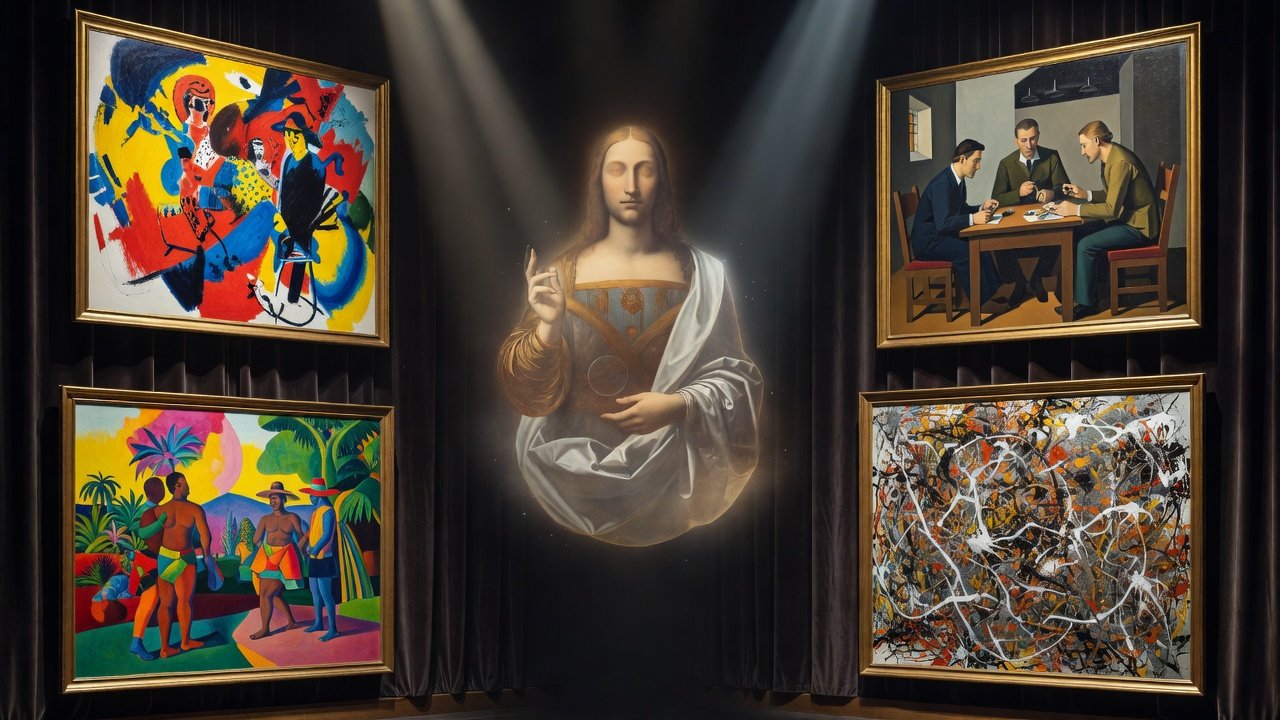
Topping every list of the most expensive paintings is Leonardo da Vinci’s Salvator Mundi (c. 1500). The painting depicts Christ holding a crystal orb and offering a blessing. It changed hands in 2017 at Christie’s New York for an astonishing $450.3 million, making it the single most expensive artwork ever sold at public auction.
The work’s provenance is dramatic: it was long thought lost until rediscovered and restored in the early 2000s. Its attribution to Leonardo remains debated among scholars, yet the market clearly voted with its wallet. Saudi Crown Prince Mohammed bin Salman is widely believed to be the buyer; the painting now resides in the Louvre Abu Dhabi. The sale underscored how scarcity, celebrity, and historical mystery can drive prices into the stratosphere.
2. Interchange – Willem de Kooning ($300 Million)
Abstract expressionist Willem de Kooning’s Interchange (1955) ranks second among the world’s costliest paintings. In 2015, hedge-fund billionaire Kenneth C. Griffin purchased the large-scale oil from the David Geffen Foundation for $300 million in a private transaction.
The painting exemplifies de Kooning’s signature frenetic brushwork and vibrant color palette. Griffin simultaneously acquired Jackson Pollock’s Number 17A, spending a combined $500 million in one day. The deal highlighted the growing appetite among ultra-wealthy collectors for blue-chip modern art that can serve both as investment and cultural prestige.
3. The Card Players – Paul Cézanne ($250 Million)
Paul Cézanne’s series of The Card Players paintings ranks among the most revered works of Post-Impressionism. One version from the series sold privately in 2011 to the royal family of Qatar for approximately $250 million, placing it firmly among the most expensive paintings ever acquired.
The composition shows two men absorbed in a card game, rendered with Cézanne’s characteristic geometric structure and muted tones. Only five versions exist; four are in museums. The sale reinforced the extraordinary value placed on rare, museum-quality Impressionist and Post-Impressionist masterpieces that rarely appear on the open market.
4. Nafea Faa Ipoipo (When Will You Marry?) – Paul Gauguin ($210 Million)
Painted in 1892 during Gauguin’s first stay in Tahiti, Nafea Faa Ipoipo captures two Tahitian women in a lush, exotic landscape. In 2015, another private sale—reportedly to the Qatari royal family—saw the canvas fetch $210 million, securing its place on the list of the world’s costliest paintings.
The work’s bold colors and flattened perspective influenced generations of modern artists. Its high price also reflects growing demand for Gauguin’s Polynesian period, which remains both celebrated and controversial for its colonial gaze. The painting now resides in a private collection, rarely exhibited to the public.
5. Number 17A – Jackson Pollock ($200 Million)
Completing our ranking is Jackson Pollock’s Number 17A (1948), an energetic drip-painting that embodies the raw power of Abstract Expressionism. Like Interchange, it was purchased in 2015 by Kenneth C. Griffin for $200 million.
Pollock’s revolutionary technique—dripping and pouring paint onto a horizontal canvas—redefined American art. The sale of Number 17A demonstrated that museum-quality Pollocks remain among the most sought-after modern works, often trading hands only in private, discreet transactions.
Why These Paintings Command Record Prices
Several factors converge to create stratospheric valuations: extreme rarity, impeccable provenance, cultural significance, and the financial power of today’s collectors. Private sales between billionaires and sovereign wealth funds frequently eclipse public auctions because they offer anonymity and speed. Meanwhile, auction houses generate publicity that further inflates perceived value.
For investors and art lovers alike, these record prices serve as benchmarks. They also raise questions about market sustainability, the role of museums in preserving cultural heritage, and the ethics of private ownership of masterpieces that many believe belong in public view.
Conclusion
The five paintings profiled here—Salvator Mundi, Interchange, The Card Players, Nafea Faa Ipoipo, and Number 17A—represent the pinnacle of the global art market. Each tells a unique story of artistic innovation and extraordinary wealth. As new records continue to be set, one thing remains clear: the world’s costliest paintings will always captivate our imagination and fuel debate about the true value of art.